Alcohol-free beer has become a popular choice for those looking to cut back on alcohol, but misconceptions still persist. Here’s what you need to know:
- It’s not completely alcohol-free: Most alcohol-free beers in the UK contain up to 0.5% ABV, which is similar to the natural alcohol levels in ripe fruit or bread.
- It’s real beer: Made with the same ingredients and brewing methods as regular beer, with alcohol removed or reduced.
- It tastes better now: Modern techniques like vacuum distillation preserve flavour, making today’s alcohol-free beers far from bland.
- Trace alcohol isn’t harmful: The tiny amounts of alcohol are metabolised quickly and are safe for most people.
- It still offers relaxation: The ritual, taste, and social experience of drinking beer remain intact, even without alcohol.
- It’s for everyone: From fitness enthusiasts to designated drivers, alcohol-free beer appeals to a wide range of drinkers.
- It’s not a gimmick: Advanced brewing processes ensure quality and flavour, making it a serious contender in the beer market.
Alcohol-free beer has evolved significantly, offering taste, health benefits, and inclusivity without compromising on the beer-drinking experience.
Inside The Unlikely Rise Of Nonalcoholic Beer
sbb-itb-a752bf8
1. Alcohol-Free Beer Contains No Alcohol At All
Myth busted: Despite its name, alcohol-free beer isn’t entirely devoid of alcohol. In the UK, many alcohol-free beers actually contain small traces of alcohol.
The reality: Under UK regulations, "alcohol-free" means a drink has an alcohol by volume (ABV) of 0.05% or less. Drinks with an ABV between 0.05% and 0.5% are labelled "de-alcoholised" instead[6]. However, many beers sold as "alcohol-free" in UK stores can contain up to 0.5% ABV. This discrepancy often arises because some products are imported from the EU, where 0.5% ABV is considered alcohol-free. Additionally, UK producers sometimes adopt these international standards to stay competitive globally[5][7].
There’s ongoing discussion in the UK about aligning its alcohol-free threshold with international standards by raising the limit to 0.5% ABV. Matt Lambert, Chief Executive of The Portman Group, commented on this potential change:
"We welcome the government explicitly considering our longstanding position to raise the alcohol-free threshold to 0.5% ABV in line with international peers"[4].
Why it’s not a big deal: The trace amounts of alcohol in these beers are so minimal they’re practically negligible. For instance, a pint of beer at 0.5% ABV contains just 0.28 units of alcohol[1]. To match the alcohol in one standard pint of 4.4% beer, you’d need to drink eight pints of 0.5% beer in an hour[5].
Research supports this, too. A 2012 study found that drinking 1.5 litres of 0.4% ABV beer resulted in blood alcohol levels 100 times lower than Scotland’s drink-driving limit[8].
To give some context, trace alcohol isn’t unique to beer. Everyday foods like ripe bananas (0.4%–0.6% ABV), burger rolls (up to 1.28g of alcohol per 100g), and apple juice (around 0.26% ABV) contain similar tiny amounts of naturally occurring alcohol[5][7]. So, the alcohol in these beers is comparable to what you’d find in a regular snack or drink.
2. Alcohol-Free Beer Isn't Real Beer
Myth busted: Yes, alcohol-free beer is real beer. It's made using the same fundamental ingredients and traditional brewing techniques as its alcoholic counterpart.
The reality: Just like regular beer, alcohol-free beer starts with water, malted grains, hops, and yeast. The brewing process - mashing (where grains are mixed with hot water to convert starches into sugars), boiling the wort with hops, and often fermentation - follows the same steps. As BrewDog puts it:
"Brewing any type of beer, with or without alcohol, starts the same way. Whether it's IPA or lager, it all begins with a process called mashing"[12].
The real difference comes down to how the alcohol is handled during production.
What makes it different: The distinction lies in the alcohol management. Some brewers stop fermentation early by cooling the liquid to near-freezing temperatures, halting yeast activity before much alcohol forms. Others allow full fermentation to develop richer flavours and then remove the alcohol using methods like vacuum distillation or reverse osmosis[10].
Examples in practice: Take Heineken 0.0, for instance. They use a double-brew process, fully fermenting the beer to develop its flavour before removing the alcohol. As Global Master Brewer Willem van Waesberghe explained:
"This blending process allowed them to make 0.0 taste more like actual Heineken, preserving that distinctive skunky character regular drinkers know and love"[13].
Similarly, Athletic Brewing Company created their own unique process, testing over 100 batches to ensure their beer stays below 0.5% ABV while maintaining a satisfying flavour profile[13].
3. Alcohol-Free Beer Tastes Watery or Inferior
Myth busted: The idea that alcohol-free beer tastes bland or subpar is outdated. Thanks to advancements in brewing techniques, alcohol-free beers now deliver flavours and textures that can stand shoulder-to-shoulder with traditional beers.
The reality: In the past, older brewing methods relied on high heat to remove alcohol, which often stripped away the beer's flavour and aroma. Today, brewers use vacuum distillation, a process where alcohol is removed at lower temperatures by reducing atmospheric pressure. This preserves the beer's original flavour profile. Additionally, brewers tweak their recipes by adding more hops and balancing unfermented sugars to replicate the mouthfeel that alcohol typically provides. Another innovation, aroma capture technology, ensures that volatile compounds lost during dealcoholisation are recovered and reintroduced into the beer. Shane McNamara, Beer Education Lead at AB InBev, highlights this progress:
"In earlier methods, much of the beer's aroma was lost during the process. Now, brewers can capture and reintroduce these aromatic compounds into the beer"[14].
These advancements have not only improved the taste but also sparked greater consumer interest.
The numbers don't lie: From 2021 to 2023, retail sales of low- and no-alcohol beer in the UK increased by 28.7%[14]. In 2023 alone, over 120 million pints of no- and low-alcohol beer were consumed in the UK[15]. This growth is fuelled by a combination of health-conscious choices and the enhanced quality of alcohol-free options.
Success stories in action: Real-world examples demonstrate the impact of these innovations. Firebrand Brewing Co's "Shorebreak", launched in 2022, quickly became their best-selling canned beer[14]. Similarly, Lucky Saint's founder dedicated two years to refining their process, collaborating with six breweries across three countries before settling on vacuum distillation[14]. Willem van Waesberghe, Global Master Brewer at Heineken, explains the approach:
"Heineken and Heineken 0.0 aren't the same taste, but the flavour and aroma profile is very close, and we try to make the brain think it is the same"[14].
4. The Trace Alcohol in Alcohol-Free Beer Is Harmful
Myth busted: The trace amounts of alcohol in alcohol-free beer (up to 0.5% ABV) are completely safe for healthy adults. Your body processes these tiny amounts so quickly that intoxication simply isn’t possible.
To put it into perspective, a pint of 0.5% ABV beer contains about 2.2g of alcohol. For the average person, this is metabolised in just 16 minutes. A 2012 study even showed that drinking 1.5 litres of 0.4% ABV beer in an hour only raised blood alcohol levels to 0.0056%. That’s 14 times lower than the UK drink-driving limit of 0.08% and far below the 0.04% threshold where people might start to notice mild effects of alcohol [17]. As Tom Hallett, Founder of Steady Drinker, explains:
"The main reason why your blood alcohol content can't build up to a level that makes you feel drunk is because your body processes the alcohol in a low‐alcohol beer almost as quickly as you drink it." [17]
Everyday exposure: Interestingly, many common foods naturally contain alcohol in amounts similar to alcohol-free beer. Ripe bananas, for example, or certain bakery items regularly expose us to trace alcohol without any concern.
That said, some people should avoid these drinks. For individuals recovering from alcohol dependency, the flavour and aroma could trigger cravings. Pregnant women and those who need to abstain entirely for health or religious reasons should also be cautious [1][9][18]. Dr Caomhán Logue, Senior Lecturer in Dietetics at Ulster University, advises:
"I would caution against assuming all drinks that are labelled in this way have no alcohol, because the recommendations by government do allow for some." [2]
5. Alcohol-Free Beer Lacks the Relaxing Effects of Beer
Myth busted: Relaxation isn’t just about the alcohol - it’s about the rituals, sensory experiences, and social moments that alcohol-free beer can also provide.
The role of ritual: There’s something inherently calming about the process of enjoying a drink. Pouring a beer into a glass, listening to the fizz, and savouring that first sip are all part of the experience. Cocktail expert Pritesh Mody emphasises this by saying:
"It's really important you put the same care and attention into the visuals of your non-alcoholic [drink] as your alcoholic version" [2].
The choice of glassware, the presentation, and the complex flavour profiles - often with subtle sour or acidic notes - help recreate the familiar and comforting experience of drinking beer.
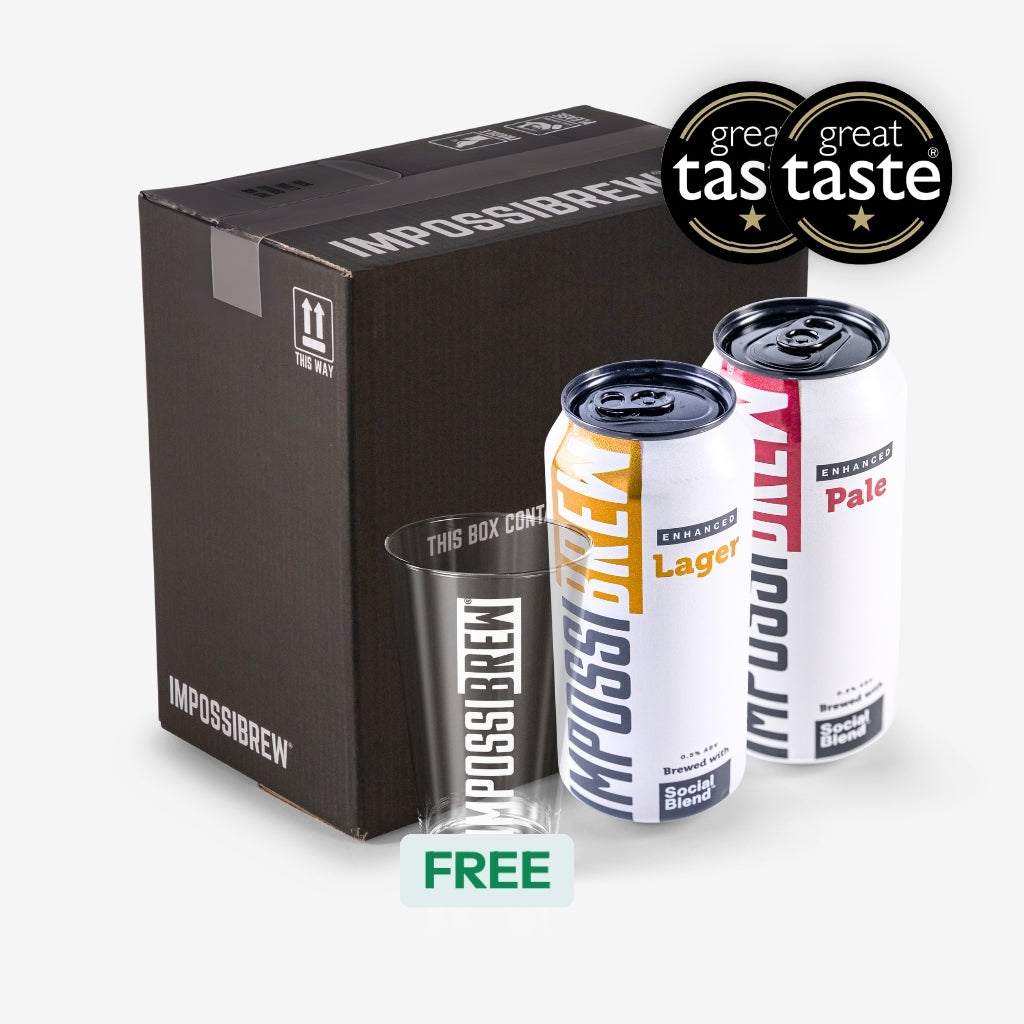
Crafting the experience: Today’s alcohol-free beers aren’t an afterthought; they’re carefully designed to deliver on taste and enjoyment. Take IMPOSSIBREW®, for example. Their Social Blend™ is specifically crafted to retain the authentic taste of beer while preserving the sensory rituals that make drinking it so pleasurable. This attention to detail ensures that the experience feels complete, even without alcohol.
The social factor: Relaxation also comes from the social context of drinking. Sharing a well-crafted beer - alcoholic or not - enhances the overall experience. Dr Duane Mellor, a dietitian and spokesperson for the British Dietetic Association, highlights this:
"There's always been a need for a grown-up non-alcoholic drink for people who want to socialise" [2].
In fact, between 15% and 20% of people opt for non-alcoholic drinks due to perceived health benefits [2]. Additionally, 38% of UK drinkers now regularly enjoy low- or no-alcohol options, up from 29% in 2022 [2]. Being able to join in social rituals without the pressure to consume alcohol adds to the sense of relaxation.
Relaxation isn’t tied exclusively to alcohol. It’s a blend of sensory enjoyment, thoughtful presentation, and meaningful social interactions - proving that alcohol-free beer can offer a genuinely calming experience.
6. Alcohol-Free Beer Is Only for Teetotallers or Recovering Alcoholics
Myth busted: Alcohol-free beer is far from being limited to a single group of people. Its appeal stretches across a wide range of consumers, including fitness enthusiasts, designated drivers, pregnant individuals, and those exploring sobriety. It’s not just a drink for those who avoid alcohol entirely - it’s becoming a choice for anyone seeking balance.
Health-conscious moderates: A significant number of alcohol-free beer fans are not teetotallers. Instead, they’re regular drinkers who want to cut back for health or lifestyle reasons. In fact, 22% of people reducing their alcohol consumption cite health as their main motivation [3]. Alcohol-free options allow them to enjoy a sophisticated drink without the added calories - especially since alcohol alone provides 7 calories per gram [2]. This makes it a popular choice for those managing their weight while still enjoying social events.
Athletes and fitness-focused consumers: Alcohol-free beer has found favour with athletes and fitness enthusiasts due to its nutritional benefits. Unlike traditional beer, it doesn’t just add empty calories. It’s packed with B vitamins, folic acid, potassium, iron, and zinc. Research even hints at potential antioxidant and anti-inflammatory properties [3]. For those aiming to stay at their physical best, these beers offer the taste of beer without compromising recovery or performance the next day [2].
Social drinkers and designated drivers: Alcohol-free beer also appeals to social drinkers who want a sophisticated alternative to sugary soft drinks. Whether you’re the designated driver, expecting a baby, or simply avoiding a hangover, these beers offer a complex mix of flavours - like sourness, acidity, and bitterness - that soft drinks just don’t provide. It’s no surprise that 38% of UK drinkers now enjoy low- and no-alcohol options regularly, a significant rise from 29% in 2022 [2].
The Dry January effect: Initiatives like Dry January have further boosted the popularity of alcohol-free beer. In 2023, around 9 million UK adults participated, and 70% of them maintained reduced alcohol consumption six months later [3]. This reflects a broader shift in drinking habits. Globally, the non-alcoholic beer market is thriving, with projections to exceed $25 billion by 2024, growing at an annual rate of 8% - a sharp contrast to the slower 1.8% growth forecast for traditional beer [3].
7. Producing Alcohol-Free Beer Is a Gimmick, Not Traditional Brewing
Myth busted: The idea that alcohol-free beer is just a gimmick doesn't hold up. Its production is deeply rooted in traditional brewing methods, using the same core ingredients: water, malt, hops, and yeast [20]. The early stages - mashing, lautering, boiling, and fermentation - mirror those of regular beer, allowing the brew to develop its full flavour profile before any alcohol is adjusted. These time-tested techniques form the backbone of methods that ensure the quality of alcohol-free beer is never compromised.
Proven techniques, not shortcuts: Brewers use advanced methods to reduce or remove alcohol while keeping the flavour intact. Techniques like vacuum distillation (where beer is heated at around 30°C under low pressure to protect delicate hop aromas), reverse osmosis (filtering out alcohol and water molecules but retaining flavour compounds), and arrested fermentation (stopping yeast activity by cooling the brew to near-freezing) are all part of the process [10] [12] [19] [20]. Science journalist Kit Chapman sums it up well:
"No yeast, no fungus creating ethanol, no flavour." [11]
Precision and craft at the core: Creating alcohol-free beer is far from simple - it’s a craft that requires skill and precision. For example, in 2017, Heineken introduced Heineken 0.0 using a double-brew process. With their proprietary A-yeast, two batches were fermented before the alcohol was removed, ensuring the beer retained the signature taste of their lager [13]. Similarly, IMPOSSIBREW, established in 2021, uses "natural cryogenic fermentation", a sub-zero brewing method that produces beer with less than 0.5% ABV without needing to remove alcohol, preserving the full character and body of traditional craft beer [10].
Industry growth proves its importance: The alcohol-free beer market is anything but a passing trend. Major breweries are making significant investments in this space. By the end of 2023, Guinness had nearly tripled production of its alcohol-free brand at St. James's Gate. Meanwhile, in the UK, the market reached a value of over £350 million in 2021, with 85% of pubs now offering at least one alcohol-free option [11] [19].
Conclusion
The myths surrounding alcohol-free beer have been thoroughly debunked, thanks to advancements in brewing techniques like low-pressure extraction and cryogenic fermentation. These methods now make it possible to craft alcohol-free beers with rich, full-bodied flavours. As Dr Duane Mellor, Dietitian and spokesperson for the British Dietetic Association, points out:
"I think previously, part of the problem was they weren't very good and now with some of the low-pressure extraction methods for alcohol, you [can] actually make a reasonably good beer or wine"[2].
This progress is echoed in the growing popularity of alcohol-free beer, which is increasingly becoming a mainstream choice. The shift is largely driven by its health benefits - fewer calories, no hangovers, and less strain on the liver. Dr Caomhán Logue, Senior Lecturer in Dietetics at Ulster University, highlights:
"There's been a culture change in terms of attitudes to having a night out without booze"[2].
Alcohol-free beer is, in essence, real beer. It’s brewed with traditional ingredients and processes, containing only trace amounts of alcohol - similar to what you’d find in ripe bananas or orange juice. It offers an authentic beer experience, providing relaxation without the usual drawbacks, making it an excellent fit for a balanced lifestyle. Whether you're cutting back on alcohol or simply seeking better-tasting options, today’s alcohol-free beers deliver quality like never before.
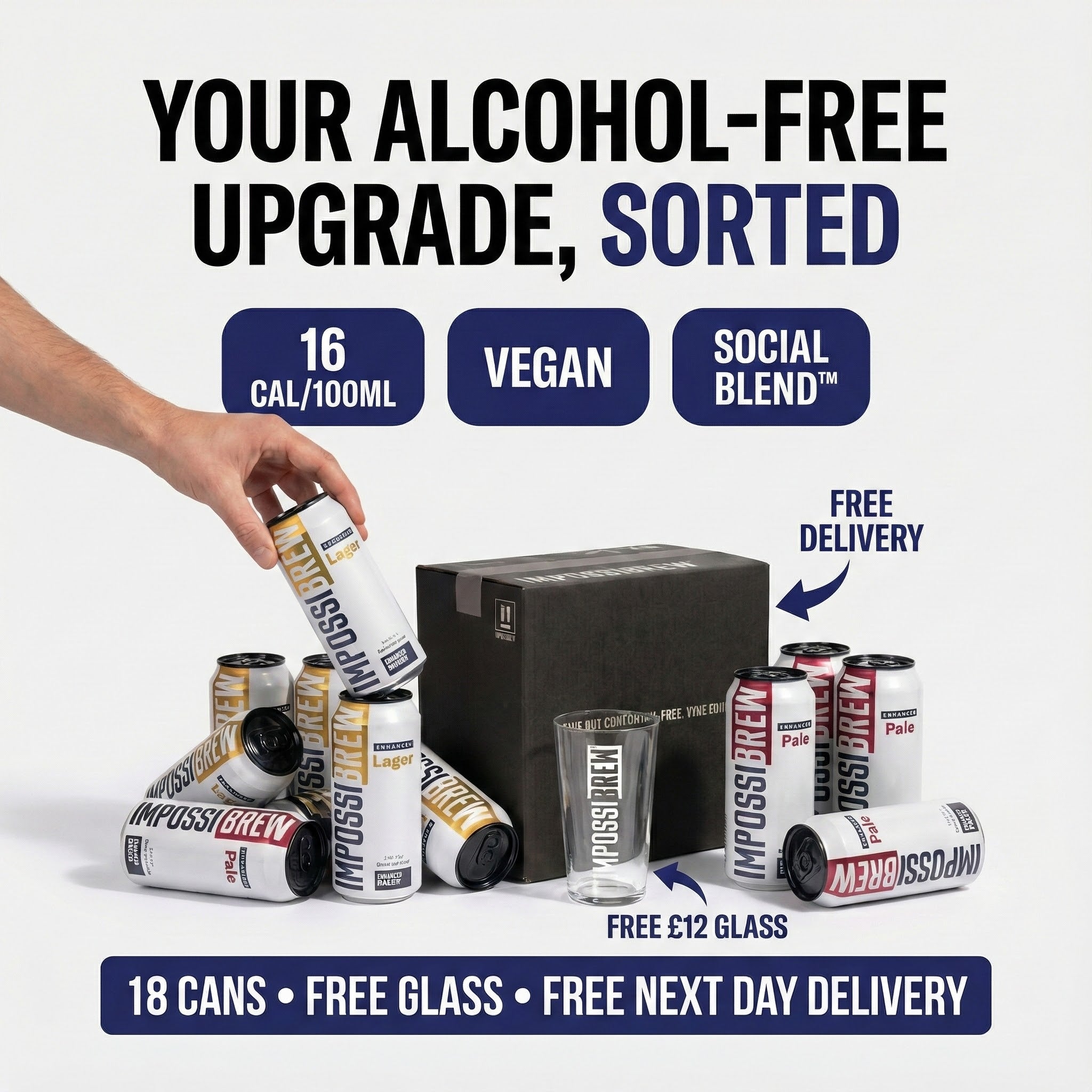
For a standout experience, try the award-winning IMPOSSIBREW® Enhanced Lager. Featuring its proprietary Social Blend™, it recreates that satisfying "one-pint feeling." With over 1,200 reviews and a 4.8-star rating, it was crowned the UK's Best Non-Alcoholic Beer at the World Beer Awards 2023[16]. Explore the Bestseller Bundle (£49.99 for 18 beers, including a free glass) and enjoy a 30-day money-back guarantee, plus free delivery on orders over £35[16].
FAQs
Will alcohol-free beer show up on a breathalyser?
Alcohol-free beer can occasionally show up on a breathalyser because it can contain up to 0.5% ABV. However, this minimal alcohol content is highly unlikely to lead to intoxication or produce notable readings on most devices. That said, it’s always wise to factor in the sensitivity of the breathalyser you're using and the amount you've consumed before getting behind the wheel.
Is alcohol-free beer suitable in pregnancy or for people avoiding alcohol completely?
The NHS advises against consuming alcohol during pregnancy, including alcohol-free beer. While these drinks are marketed as alcohol-free, they can sometimes contain trace amounts of alcohol, which may pose risks to the baby.
If you're avoiding alcohol completely during pregnancy, it's always a good idea to consult a healthcare professional. They can guide you on whether certain alcohol-free beverages are safe, as some might also include ingredients unsuitable for specific health conditions.
How can I tell the difference between 0.0%, alcohol-free and de-alcoholised on the label?
Alcohol-free drinks usually have 0.0% ABV, meaning no alcohol content at all. On the other hand, de-alcoholised beers go through a process to remove alcohol but can still contain tiny amounts - up to 0.5% ABV. In the UK, drinks with this level of alcohol are classified as low-alcohol rather than entirely alcohol-free.