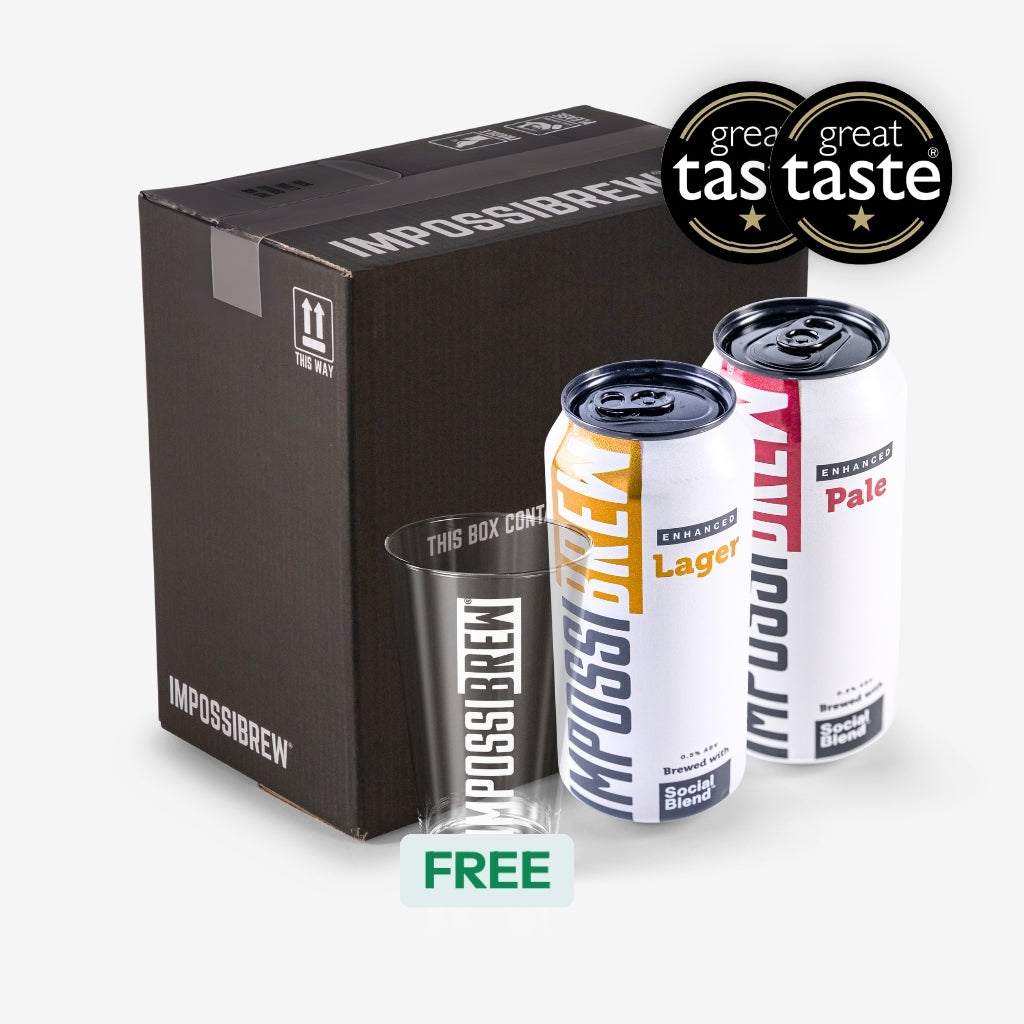
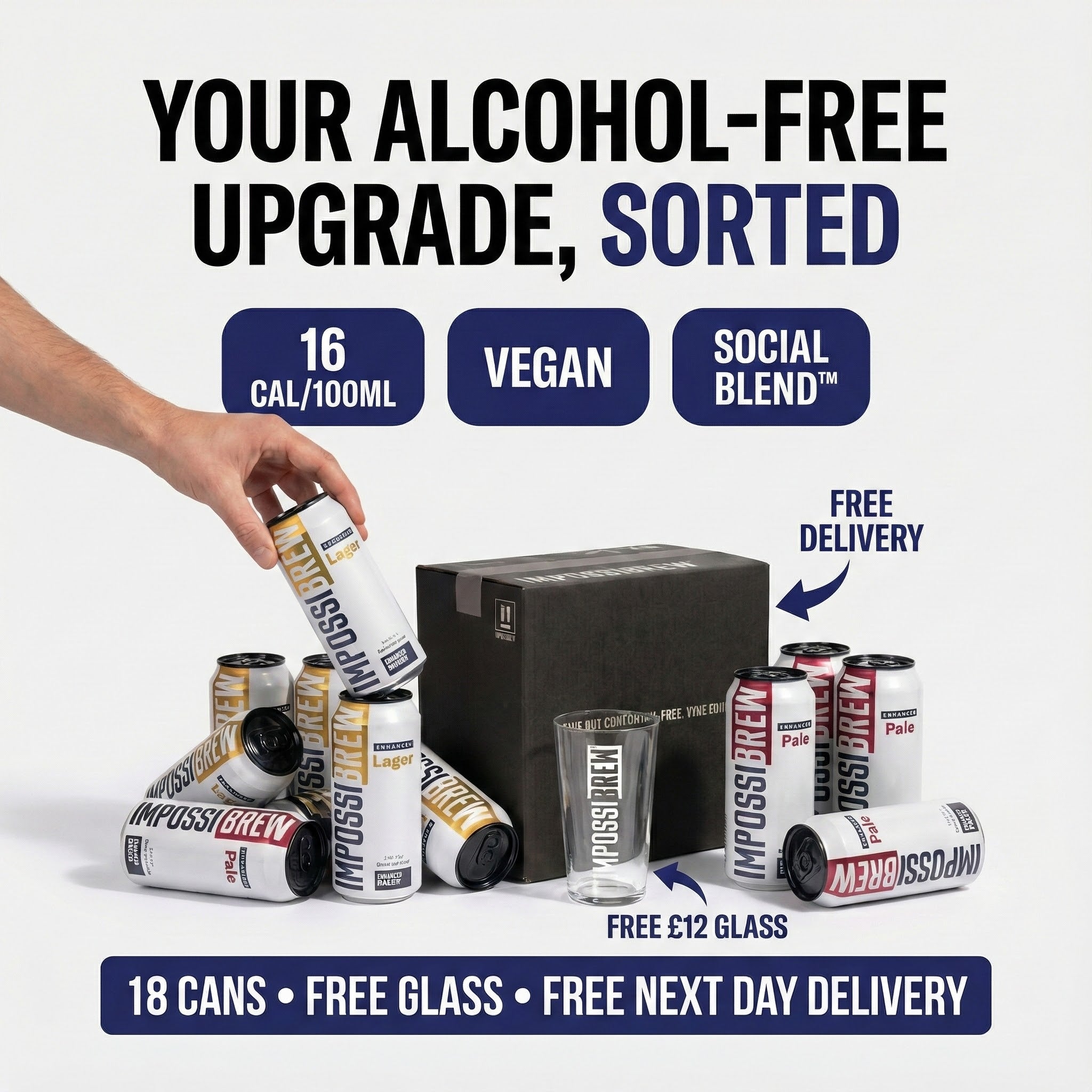
Functional beers are reshaping the non-alcoholic beer market by combining low-calorie brewing with ingredients like L-theanine and ashwagandha for relaxation and wellness. Unlike regular non-alcoholic beers, which often rely on added sugars to replace lost flavour, functional beers use advanced brewing techniques to deliver a better taste with fewer calories. For example, IMPOSSIBREW®'s Enhanced Lager contains just 17 calories per 100ml compared to a typical 330ml beer with 5% ABV, which is around 150 calories.
Key takeaways:
- Functional beers focus on flavour and wellness with minimal calories.
- Advanced brewing methods like cryogenic fermentation reduce calorie content without added sugars.
- Ingredients such as soluble fibres improve mouthfeel, while nootropics and botanicals offer relaxation benefits.
For health-conscious drinkers, functional beers offer a smarter choice: fewer calories, no alcohol, and added wellness benefits.
Research on Calorie Control in Non-Alcoholic Beers
Metabolic Effects of Daily Non-Alcoholic Beer Consumption
Studies reveal that non-alcoholic beers (NABs) influence metabolism differently depending on the type consumed. For instance, a 2025 study observed the effects of drinking 660 ml of NAB daily over four weeks in healthy young men. The results varied significantly between pilsener, wheat, and mixed beers (those combined with lemon or orange soda).
Mixed beers were linked to higher fasting glucose and triglyceride levels, while wheat beers caused an increase in insulin and C-peptide levels. On the other hand, pilsener-style NABs, along with water, reduced total cholesterol and LDL levels. However, pilsener consumption also raised HbA1c levels by 0.16 percentage points (p = 0.0016) [7].
Henriette Kreimeyer from Ruhr-University Bochum’s Department of Medicine commented, "The metabolic alterations seen are probably due to the caloric and sugar content in NABs, rather than polyphenols" [11].
This underscores the importance of calorie sources, not just calorie quantity, in determining metabolic outcomes.
Interestingly, pilsener consumption also influenced gut health by reducing Firmicutes diversity and increasing Actinobacteriota. It further lowered the liver apoptosis marker M30, hinting at a potential protective effect [7]. These findings set the stage for a closer examination of calorie and sugar content across various NAB styles.
Calorie Profiles Across Different Beer Types
The calorie and sugar content of NABs can differ significantly due to variations in brewing techniques and residual sugars. Below is a comparison of key metabolic effects alongside calorie and sugar data for four weeks of daily consumption:
| Beer Type (per 100 ml) | Energy (kcal) | Sugars (g) | Metabolic Effects |
|---|---|---|---|
| Pilsener (NAB) | 21 | 0.5 | Lowered cholesterol/LDL; increased HbA1c; reduced gut diversity [7] |
| Mixed Beer (NAB) | 31 | 5.4 | Raised fasting glucose and triglycerides; reduced ALT/AST [7] |
| Wheat Beer (NAB) | 26 | 3.3 | Increased insulin and C-peptide; reduced body fat percentage [7] |
| Water (Control) | 0 | 0 | Reduced cholesterol/LDL; lowered liver apoptosis marker (M30) [7] |
| Enhanced Lager | 17 | 0.7 | Balanced flavour with functional ingredients [8] |
| Triple Hopped IPA | 11.8 | 1.1 | Contains L-theanine and Ashwagandha for added benefits [8] |
Mixed beers stand out with sugar levels exceeding ten times that of pilseners (5.4 g vs 0.5 g per 100 ml), contributing to their more negative effects on glucose and lipid metabolism. Wheat beers, while lower in sugar than mixed beers, still prompted insulin responses not seen with pilsener-style NABs [7].
Functional beers, such as IMPOSSIBREW®'s Enhanced Lager, have managed to achieve a lower sugar and calorie profile compared to traditional wheat beers (≈3.6 g sugar/100 ml). By employing advanced brewing techniques and incorporating functional ingredients, these beers contain just 17 calories and 0.7 g of sugar per 100 ml [8].
Nutritional Composition and Calorie Sources
How Brewing Methods Affect Calorie Content
The way non-alcoholic beer is brewed has a direct impact on its calorie content. Traditional alcohol removal methods, such as vacuum distillation or reverse osmosis, often remove not just ethanol but also some flavour compounds. To compensate for the loss of flavour, brewers sometimes add sugars like lactose, fructose, or high fructose corn syrup, which can significantly increase the final calorie count [5].
On the other hand, limited fermentation techniques - using specialised yeasts or stopping fermentation early - help control residual sugars without the need for added sweeteners. This approach can produce beers with as little as 6 calories per 100 ml [3][5]. The type of malt used also plays a role in calorie content. Darker malts, for example, tend to leave behind more unfermentable sugars. While alcohol itself contributes about 7 calories per gram, its removal only reduces the overall calorie count if no extra carbohydrates are added during the process [3][5].
"The choice of production technique plays a crucial role in determining the final calorie count of non-alcoholic beers." - IMPOSSIBREW® Journal [5]
These brewing insights highlight how calorie content is influenced by production methods, laying the groundwork for strategies aimed at creating lower-calorie options.
Methods for Reducing Calories in Non-Alcoholic Beers
Several techniques have been developed to keep the calorie content of non-alcoholic beers low while preserving their flavour. Methods like cryogenic distillation or limited fermentation allow brewers to maintain authentic taste without relying on added sweeteners [2][5]. Another approach involves optimising the wort to reduce fermentable sugars from the start. Additionally, functional ingredients like L-theanine, Ashwagandha, and soluble plant fibres can replace alcohol's role, helping to avoid unnecessary caloric additions [2][3].
For those watching their calorie intake, checking labels for added sugars such as high fructose corn syrup or lactose is essential. Beers that are brewed as low-alcohol (0.5% ABV) from the beginning generally require fewer additives and contain fewer calories overall [2][5].
IMPOSSIBREW® incorporates these advanced brewing techniques to create non-alcoholic beers with minimal calories, catering to the growing demand for healthier options in the UK market.
Functional Ingredients for Calorie Control
Low-Calorie Ingredients: Nootropics, Adaptogens, and Polyphenols
Functional beers are crafted with ingredients that not only offer health benefits but also keep the calorie count in check. Unlike alcohol, which adds around 7 calories per gram [3], these ingredients enhance the beer's sensory appeal without unnecessary calories.
Take nootropics like L-theanine, for example. They help promote alpha brain waves and boost serotonin levels, encouraging a sense of calm and focus. Then there are adaptogens such as ashwagandha root, which are known to reduce stress and anxiety, providing a natural way to relax. Meanwhile, polyphenols from citrus extracts bring antioxidant properties and a flavour boost, all without relying on added sugars.
To ensure that the beer retains its satisfying texture and body - often compromised when alcohol and sugars are removed - soluble plant fibres are added. These fibres enhance the mouthfeel, giving the beer that familiar full-bodied sensation. This balance allows functional beers, like those from IMPOSSIBREW®, to deliver the richness of traditional beers while keeping calorie counts as low as 11.8 to 17 kcal per 100 ml. By combining these bioactive ingredients, functional beers achieve a low-calorie profile without sacrificing taste or texture.
| Functional Ingredient | Category | Key Benefit | Calorie Impact |
|---|---|---|---|
| L-Theanine | Nootropic | Promotes relaxation and enhances alpha brain waves | Negligible |
| Ashwagandha Root | Adaptogen | Reduces stress and anxiety; supports mood regulation | Negligible |
| Soluble Plant Fibre | Dietary Fibre | Improves mouthfeel and body; adds fullness | Low |
| Vitamin B1 | Vitamin | Supports mood regulation and reduces tiredness | Zero |
| Citrus Extract | Botanical | Enhances flavour profile without added sugars | Low |
How Proprietary Blends Achieve Calorie Control
Proprietary blends take these functional ingredients and combine them in a way that balances flavour and calorie control. In 2021, IMPOSSIBREW® introduced their Social Blend™, developed in collaboration with experts. This unique blend includes L-theanine, ashwagandha, and soluble plant fibres, all working together to mimic the sensory and social pleasure of sipping a traditional pint. The result? A beer that delivers the same enjoyment but with calorie counts as low as 11.8 to 17 kcal per 100 ml. This innovation even earned IMPOSSIBREW® a Gold Medal at the London Beer Competition [2][10].
"Social Blend™ is our proprietary alcohol alternative made from a blend of science-backed ingredients... designed to replicate the sensory and social relaxing experience of drinking." - IMPOSSIBREW®
The formulation also uses cryogenic fermentation, a technique that preserves the authentic flavour and texture of beer while maintaining an ABV of just 0.5% and keeping calories to a minimum. In a survey of over 1,000 participants, more than 70% reported feeling relaxed after consuming functional beer containing Social Blend™, and 88% said they reduced their consumption of traditional alcohol after making the switch [2][4].
These carefully crafted formulations highlight how functional ingredients can replace alcohol's role in beer without resorting to high-calorie additives or excessive sugar. This progress opens the door to future advancements in calorie-conscious brewing.
sbb-itb-a752bf8
Future Directions for Functional Beers
Research Gaps and Opportunities for Development
Even with recent progress, there are still some hurdles to overcome in the development of functional beers. One of the main challenges is the flavour-calorie trade-off. Removing alcohol often affects the beer's mouthfeel and body, leading brewers to use added sugars like lactose or fructose to compensate. However, this can significantly boost the calorie content [5]. Striking a balance between maintaining the beer's sensory qualities and keeping calories in check remains a complex issue.
Another area needing attention is bioactive stability. Processes like pasteurisation can reduce the effectiveness of functional ingredients [9]. Additionally, there’s limited understanding of how beer’s composition influences the absorption of nootropics and adaptogens [9]. For example, research conducted in September 2025 by the Slovak University of Technology and the University of Chemistry and Technology in Prague explored the use of Pichia manshurica yeast in non-alcoholic beer production. While the yeast successfully kept ethanol levels below 0.5%, it left high residual sugar levels because it only consumed a small portion of the available glucose and maltose [12]. This highlights the need for more efficient brewing methods that can tackle such issues.
Although the probiotic market is expanding, non-alcoholic beer still occupies a niche space within it [12]. Bridging these gaps is crucial for meeting the evolving expectations of health-conscious consumers.
Meeting UK Health-Conscious Consumer Needs
These technical challenges are closely tied to the growing demand for beverages that promote health without sacrificing flavour or enjoyment. In the UK, consumers are increasingly drawn to drinks that not only taste good but also offer functional benefits. Shifting the narrative from "alcohol-free" to "enhanced" positions functional beers as a healthier, benefit-driven choice.
Some functional beers now boast calorie counts as low as 6 to 15 calories per 100ml [5][8], making them appealing for those mindful of weight management. Additionally, in the UK, beverages with an alcohol content of 0.5% ABV are classified as "dealcoholised" and are exempt from alcohol duty [1].
"The challenge of considering any potential health benefits of beer are restricted by the negative consequences of its alcohol and energy content." – Duane D. Mellor, Aston Medical School [9]
A 2025 study involving over 2,000 participants revealed that 84% felt more relaxed after drinking a functional beer infused with a proprietary botanical blend [1]. This underscores the fact that UK consumers are actively seeking drinks that deliver specific physiological benefits, such as stress relief and relaxation, while maintaining ultra-low calorie options.
At IMPOSSIBREW®, the focus remains on advancing functional blends and brewing techniques to ensure these health benefits are seamlessly paired with an authentic beer experience.
Conclusion
Calorie control in functional beers marks a major change in how we think about social drinking. By cutting out the 7 calories per gram from ethanol and avoiding the sugary additives often found in traditional dealcoholised beers, these modern options offer authentic flavours with far fewer calories [3][5]. Studies show that traditional non-alcoholic beers already have fewer calories than their alcoholic counterparts. Functional beers take this further by adding nootropics and adaptogens, providing relaxation benefits without the extra calorie load [6][4].
New brewing techniques have emerged to build on these insights. A standout example is IMPOSSIBREW®, which uses cryogenic fermentation to achieve a natural 0.5% ABV while keeping calorie content as low as 11.8 kcal per 100ml in its Triple Hopped IPA [13][2]. Its proprietary Social Blend™, featuring L-Theanine, Ashwagandha, and Vitamin B1, recreates the "one or two pint feeling" - a sensation reported by 84% of over 2,000 participants in a 2025 study [1][4]. This approach combines flavour, wellness, and low-calorie content, redefining what beer can offer.
While technical hurdles remain, the direction is clear [5]. With more UK consumers seeking healthier lifestyles without giving up enjoyment, functional beers that combine ultra-low calories with proven wellness benefits are perfectly positioned to meet this demand. In fact, 88% of IMPOSSIBREW® users report drinking less alcohol, showing that calorie control and social enjoyment don’t have to be at odds [4]. These challenges serve as a catalyst for ongoing advancements in functional beer development.
The future of functional beers lies in refining brewing methods and ingredient combinations to deliver both health benefits and a genuine drinking experience. For UK consumers, this means achieving wellness goals without giving up the rituals they love - something IMPOSSIBREW® is uniquely equipped to deliver.
FAQs
What makes functional beers healthier than regular non-alcoholic beers?
Functional beers are made with carefully chosen ingredients that do more than just skip the alcohol. These beverages often include natural compounds such as L-Theanine and Ashwagandha, known for their potential to ease stress, boost mood, and enhance mental clarity - all without the downsides associated with alcohol.
What’s more, functional beers are often lower in calories, vegan-friendly, and gluten-free, making them a smart option for those watching their diet or managing specific dietary restrictions. Unlike many non-alcoholic beers that may rely on added sugars or pack in extra carbohydrates, functional beers prioritise wellness while still offering a flavourful and enjoyable drinking experience.
How do ingredients like L-theanine and ashwagandha improve the experience of drinking functional beers?
Ingredients like L-theanine and ashwagandha bring a new dimension to drinking functional beers, offering relaxation and promoting mental well-being. L-theanine, naturally present in green tea, is celebrated for its ability to encourage calmness without making you feel sleepy - keeping you relaxed but still alert. On the other hand, ashwagandha, an adaptogenic herb rooted in Ayurvedic traditions, is often praised for helping to reduce stress and maintain balance in the body.
By blending these research-supported ingredients into their recipes, functional beers create a drinking experience that’s both mindful and enjoyable. They offer the social and sensory joys of drinking while also supporting relaxation and mental clarity - an appealing choice for anyone exploring alcohol-free options with added wellness benefits.
How are calories reduced in functional non-alcoholic beers?
Calories in functional non-alcoholic beers are kept low through specialised brewing techniques. For instance, methods like boiling the beer to eliminate alcohol or using advanced filtration systems help reduce residual sugars. These approaches ensure the drink remains lower in calories while still delivering on flavour and quality.
In addition, some of these beers include carefully selected ingredients that improve the overall drinking experience without piling on extra calories. This makes them an appealing choice for anyone looking for a lighter, health-conscious alternative.